At present, the world is changing more rapidly than ever due to autonomous vehicles that are altering the transportation sphere. They are a combination of artificial intelligence, sensors, and connectivity to drive on roads without human intervention. This technology is assured of safer streets, quicker commuting and lesser congestion in traffic at all times.
It is important to learn the main technologies of autonomous vehicles in order to understand the future mobility trends as a beginner. These systems depend on a combination of various innovations towards proper decision-making. In 2026, the use of autonomous vehicles will affect everyday life and urban design.
Lidar Sensors
Lidar sensors are devices that utilize laser rays to determine the distances surrounding the car. They create high-resolution 3D maps for obstacle detection and navigation effectively. Lidar is one of the effective tools that autonomous vehicles may rely on to identify road-related hazards, pedestrians, and cyclists.
These sensors are important to give real-time data to plot safe driving routes. Lidar can be used in different lighting conditions, such as night or low visibility conditions. Manufacturers incorporate Lidar into cameras and radar to enhance situational awareness to a great extent
Radar Technology
Radar involves the use of radio waves in detecting the position of objects and speeding vehicles in the vicinity. It can operate in unfavorable weather like rain or fog with ease. Radar detects the obstacles and measures their speed, distance and path every single moment.
This technology is used alongside Lidar and cameras to have more powerful vehicle perception systems. Autonomous vehicles are dependent on radar in order to make split-second safety choices. Radar assists the vehicle to anticipate the occurrence of a collision and to take corrective action either on speed or direction.
High Definition Maps
The self-driving cars require HD maps to be able to locate on the roads at all times. These maps contain the details of lane limits, road traffic lights, and road elevation precisely. Vehicles compare real-time sensor data with maps to determine exact position.
HD maps eliminate the use of GPS solely and enhance the level of reliability in navigation. They enable self-driving cars to predict crossroads, curves and traffic variation successfully. The cars react to the changing conditions of the roads safely due to frequent updates of the maps.
Computer Vision
Computer vision enables cars to perceive objects and comprehend environments by use of cameras. It identifies road signs, lanes, obstacles and road lights. Machine learning algorithms make cars learn how to classify objects and predict movements.
The camera systems have great capability to monitor pedestrians, cyclists and even animals as they go through. Radar and Lidar cameras are used to give a multi-layer system of detection. The autonomous vehicles depend on vision technology to be led safely in complicated cases.
Artificial Intelligence and Machine Learning
Artificial intelligence is an effective sensor data processing and autonomous decision-making process. Machine learning enables cars to continuously acquire experiences as they go through them. AI anticipates the actions of other road users to make safe moves.
Such systems optimize routes, change speed and use brakes when necessary. AI is a combination of perception, planning, and control that creates a functional whole of autonomous driving. It enables autonomous vehicles to address unexpected events with greater precision under all circumstances.
Vehicle-to-Vehicle Communication
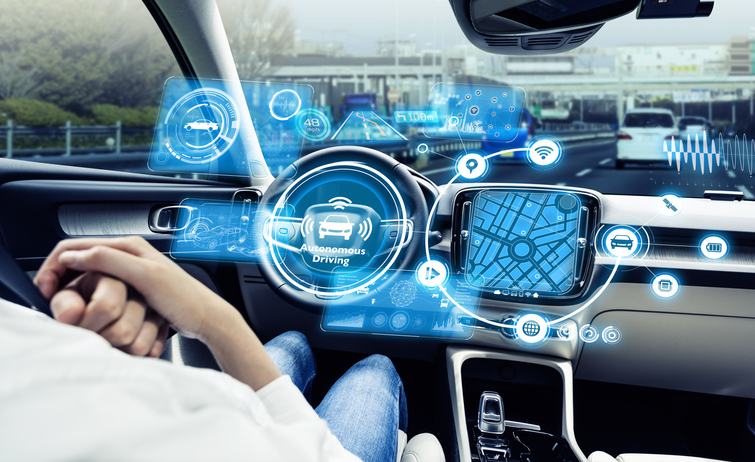
Vehicle-to-Vehicle communication is a process of transmitting the speed and location information to vehicles in real-time. It enables the vehicles to inform one another of the dangers or unexpected halts even before they happen. Through V2V systems, autonomous cars are able to organize a lane change and merge with ease.
V2V assists individuals in avoiding congestion in traffic and reducing the chances of accidents since it optimizes situational awareness. The technology creates an integrated web of vehicles that reacts dynamically collectively. The communication between vehicles is critical in the development of smart transportation systems in the world in the long run.
Vehicle to Infrastructure Communication
V2I is a type of technology that relates vehicles to traffic lights, sensors, and signs. It gives actual information concerning road conditions, the traffic and the construction areas. Self-driving cars rely on V2I data to ensure speed, route, and fuel efficiency optimization at all times.
V2I systems used in Smart Cities ensure efficient and safer movement. The technology makes autonomous vehicles communicate efficiently with the environment. V2I is essential for the rapid global use of driverless cars on a large scale.
Advanced Driver Assistance Systems
The Advanced Driver Assistance Systems offer semi-autonomous operations which make vehicles safer. It has features such as lane keeping, adaptive cruise control, and automatic emergency braking which are effective. ADAS systems act as an introduction to fully autonomous driving technologies effectively.
They allow humans to retain control while benefiting from automation support consistently. ADAS data contributes to AI learning and improves autonomous decision-making continuously. Many new vehicles include ADAS features to enhance driver safety and experience daily.
Sensor Fusion
Sensor fusion has combined data of Lidar, radar, and cameras into an accurate perception. It removes errors that take place when one sensor works alone in the wrong manner. Fusion helps autonomous vehicles to know about the environment safely and reliably.
Fusion enhances tracking, localization, and detection of objects in different conditions when driving. It allows AI systems to make accurate decisions based on complete real-time data. Sensor fusion is fundamental for high-level autonomous driving and system reliability.
Cloud Computing and Edge Processing
Cloud computing allows vehicles to access large datasets for decision-making quickly. Edge processing enables real-time computation inside the vehicle with low latency efficiently. Combined, these technologies are capable of offering quicker, smarter, and more adaptable vehicle operations all the time.
Fleet data assists AI systems in enhancing algorithms and general driving performance. The updates on the cloud enable navigation, predicting of traffic and improving software over time. Such technologies are used to transform autonomous vehicles into intelligent, sensitive, and secure in a dynamic environment.
How These Technologies Work Together
Autonomous vehicles rely on all ten technologies working together harmoniously daily. The objects are detected by sensors, data is processed by AI and maps can ensure a safe navigation. The communication of vehicles increases safety through informing about the impediments and the traffic state.
ADAS offers a human control service in the shift to complete automation in a gradual manner. With cloud and edge computing, vehicles can gain knowledge and evolve effectively with time. All the components should be integrated to provide the autonomous driving that is always consistent, accurate, and safe.
Benefits of Autonomous Vehicle Technologies

Self-driving cars minimize the mistakes of human factors and enhance general safety on the road to a considerable degree. They are effective in regard to efficiency in traffic movement and reduction of traffic congestion in cities with heavy traffic. On the one hand, AI solutions enhance fuel efficiency by making smarter decisions on the route and speed.
Autonomous technology provides mobility for the elderly, disabled, and those without licenses safely. Such vehicles reduce the costs of accidents and emergency response needs of society at all times. They are becoming smarter, sustainable and linked cities throughout the world.
Challenges and Future Considerations
Regulators, ethicists, and safety experts must plan for issues surrounding autonomous automobiles. AI models should safely address a rare event without necessarily involving human intervention. To avoid hacking or malicious interference with the vehicles, cybersecurity is crucial.
The vehicle-to-vehicle communication systems require infrastructure upgrades to be completely supported. Popularity and confidence of people are essential to the mass adoption of autonomous vehicles in the near future. Engineers use testing, validation and monitoring to make sure that vehicles perform in a safe manner when subjected to various real-world conditions.
The Future of Autonomous Vehicles
Within the next 2026, the world will be transformed by autonomous vehicles in terms of transportation and employment, as well as urban planning. Autonomous driving vehicles will save on commuting time and will improve productivity at all times. The AI-powered fleets will assist in the delivery, logistics, and emergency services.
Public transport systems will include autonomous buses and shuttles in their daily routes. Designers will design the cities of the future in a way that autonomous traffic moves safely and efficiently. Individuals, corporations and governments can prepare well by knowing the important technologies.
Conclusion
Autonomous vehicle technologies are redefining the future of mobility in the world to a large extent. Lidar and AI, as well as vehicle communication, are all necessary systems. Such innovations develop vehicles that drive safely, efficiently and intelligently daily.
Self-driving vehicles will make transport more comfortable, secure and environmentally friendly in 2026. The knowledge of these technologies renders individuals and organizations successful in getting accustomed to new changes in the future. The driving of the future will be autonomous, connected, and smarter than ever before.


