Artificial intelligence is in a fast-evolving state with new functionalities and smarter technologies. Multimodal AI is one of the most intriguing developments that is capable of perceiving alternative types of data at the same time.
In contrast to the previous AI where people provide only text or numbers to the system, multimodal AI is used to provide images, audio, video, and text simultaneously. This feature enables AI systems to perceive information more in the similar manner as humans. This guide will introduce you to the concept of multimodal AI and how it is used in the industries outside of text.
Introduction to Multimodal AI
The initial sphere of artificial intelligence was limited to the processing of structured data and written text. Initial AI machines were able to interpret documents or numbers but were not able to interpret images or sounds.
Nonetheless, contemporary AI devices are currently able to handle simultaneous processing of various types of information. These systems are a blend of text, images, voice, and video to help come up with more accurate insights. Thus, multimodal AI is one of the significant innovations in artificial intelligence technology.
What Is Multimodal AI
Multimodal AI systems are artificial intelligence systems that handle multiple data types at the same time. They are systems that combine the information of various sources and comprehend complex situations.
Indicatively, multimodal AI is capable of analyzing a photo as one reads through accompanying descriptions. It is also able to handle voice commands and process visual information. Thus multimodal systems give more accurate responses in contrast to single-input AI patterns.
How Multimodal AI Works
Multimodal artificial intelligence systems apply machine learning models that are trained on various data. These models are trained on patterns using images, text, audio and videos.
The system integrates information provided by various sources to provide outputs after training. As an example, the AI can process a picture but will be listening to a voice command. Consequently, the multimodal AI develops a more profound interpretation of real-life scenarios.
Why Multimodal AI Is Important
It is natural that human beings process information through a combination of different senses, including sight and hearing. Multimodal AI tries to achieve this capability with sophisticated algorithms.
The understanding of traditional AI models is limited due to one data source. Multimodal artificial intelligence on the other hand uses a combination of multiple inputs to give a better input. Smart digital products and services are, thus, created within multimodal systems adopted by companies.
Key Technologies Behind Multimodal AI

Multimodal artificial intelligence systems are efficient in various data types that can be facilitated by several technologies. These are technologies that use computer vision, natural language processing and speech recognition.
The machine learning models are used to extract features on images, text, and audio individually. Subsequently, dedicated neural networks combine these elements into a single intelligence. Moreover, the multimodal systems can work on massive datasets in a short time due to the powerful cloud computing platforms.
Real-World Applications Beyond Text
The current multimodal artificial intelligence is used to serve numerous real-life applications in various industries. These systems are used to enhance automation, decision-making, and customer experiences by businesses.
As an illustration, voice recognition and understanding of images or documents can be analyzed with AI assistants. On the same note, the security systems scan through video footage and identify suspicious sounds. As a result, the skills of artificial intelligence are developed by multimodal AI beyond mere text analysis.
Multimodal AI in Healthcare
One of the industries that have benefited a lot with multimodal artificial intelligence is healthcare. The AI systems used by doctors are ones that analyze medical images and records of the health of patients.
To use AI as an illustration, it can analyze X-ray images during the checking of written medical records. This integrated analysis enhances the quality of diagnosis and treatment planning. Moreover, multimodal AI will help the doctors to track the patient using the wearables and voice reports information.
Multimodal AI in Autonomous Vehicles
Self-driving cars depend much on the multimodal artificial intelligence to move safely on the roads. Self-driving vehicles take data at the same time and cover cameras, radar cameras, and GPS.
The AI interprets the visual situation on the road, traffic lights, and other vehicles near the vehicle in real time. Meanwhile, it also processes sensor data in order to identify pedestrians or obstacles. Thus, multimodal intelligence allows cars to drive more safely.
Multimodal AI in Content Creation
Multimodal AI tools are becoming more popular among content creators as a means of creating digital media more effectively. Such systems produce pictures, videos and audio based on basic text instructions.
As an illustration, a designer would be able to compose a description and create visual art automatically. On the same note, AI is capable of transforming written scripts to voice or video. As a result, multimodal artificial intelligence enhances the speed with which the marketer, designer, or filmmaker works.
Multimodal AI in E-commerce and Retail
Companies that engage online retailers apply the multimodal AI to enhance product discovery and shopping experiences. Customers are able to post photos and use them to search immediately to find similar products.
Meanwhile, AI understands product descriptions and reviews and visual information and suggests products. These suggestions assist in making customers locate the products very quickly. Thus, multimodal systems enhance customer interaction and boost sales performance in the online shop.
Multimodal AI in Education
Multimodal AI is also applied in educational platforms to establish interactive learning experiences. Videos, audio explanation, and visual diagrams can all be used to educate students at the same time.
AI tutors examine the responses of the students and regulate lessons according to the pattern of learning. Such customized systems assist the students to comprehend complicated issues better. Consequently, the multimodal AI promotes more interactive and adaptive digital education systems.
Advantages of Multimodal AI
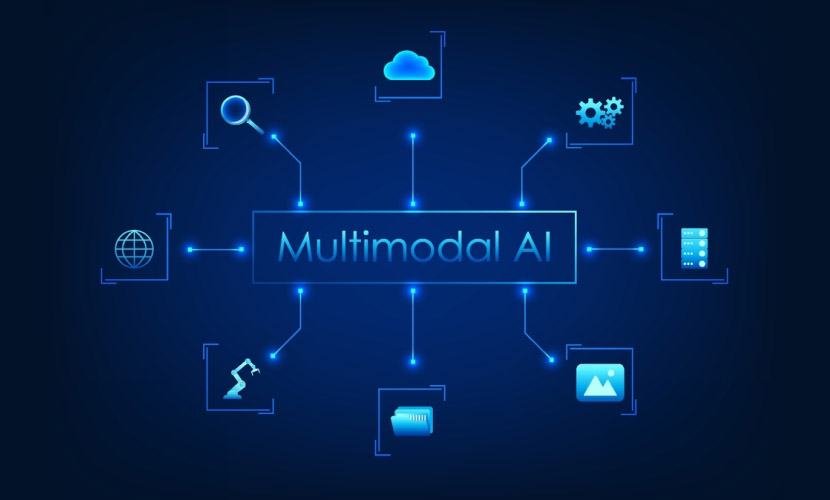
There are some benefits associated with multimodal AI in contrast to the single-input AI models. These advantages enhance the performance in most industries and applications.
To begin with, multimodal systems yield more precise outputs because the systems examine various data sources. The various types of data present supplementary information that enhances comprehension.
Second, these systems bring more natural relations between machines and humans. The users are able to chat through voice, images or text at the same time. Lastly, multimodal AI allows new applications that could not be implemented using the older AI technologies.
Multimodal AI Systems Problems
Irrespective of its upsides, multimodal AI continues to experience a number of technical and practical difficulties. The creation of these systems is carried out with the help of large datasets, which include several types of data.
Images, videos, and audio training models are very resource-intensive in terms of computing resources. Firms have to deal with an intricate process of data integration too. Also, data privacy and ethical application of AI are also issues that need to be addressed.
Future of Multimodal AI
Multimodal AI has a very bright future with the technology ever advancing at a very high rate. Models are being constructed by researchers that comprehend even more intricate associations of data.
Future systems will be able to interpret gestures, facial expressions and signals in the environment concurrently. These functions will enable AI to communicate more with human beings. As a result, AI in various modes will be important in the upcoming generation of intelligent technology.
Key Takeaways
- Multimodal AI can handle several forms of information such as text, images, audio, and so on.
- Such systems are a combination of computer vision, speech recognition and language processing systems.
- Multimodal artificial intelligence enhances accuracy and analyzes multiple sources of data at the same time.
- Healthcare, retail, and autonomous vehicles are some of the industries that are being supported by this technology.
- Multimodal artificial intelligence is employed to construct interactive digital experiences by the content creators and educators.
- The next generation AI systems would also include more sensory information in making decisions.
Conclusion
The concept of multimodal AI is a significant advancement in the development of technologies of artificial intelligence. These systems bring together text, images, audio and video data to establish greater insight into complex situations.
Multimodal intelligence has already been applied in industries like healthcare, transportation, education and e-commerce. These systems help businesses to enhance automation, decision-making and user experiences. Multimodal AI will drive most of the smart systems of the next wave of technology as more research develops.
FAQ
What is multimodal AI?
Multimodal AI is an artificial intelligence system that achieves processing over more than one type of data at a time. Such types of data are text, images, audio and video.
What is the difference between multimodal and traditional AI?
Conventional AI systems tend to process one data source including text or numbers. Multimodal AI involves integrating a number of data sources to form more precise insights.
In what applications today is multimodal artificial intelligence used?
Healthcare Multimodal AI is applied in healthcare, autonomous vehicles, digital assistants, education platforms, and online retail systems.
What is the relevance of multimodal artificial intelligence?
Multimodal AI enhances understanding by the machine by integrating various sources of information. This solution will allow making more precise predictions and intelligent digital applications.


